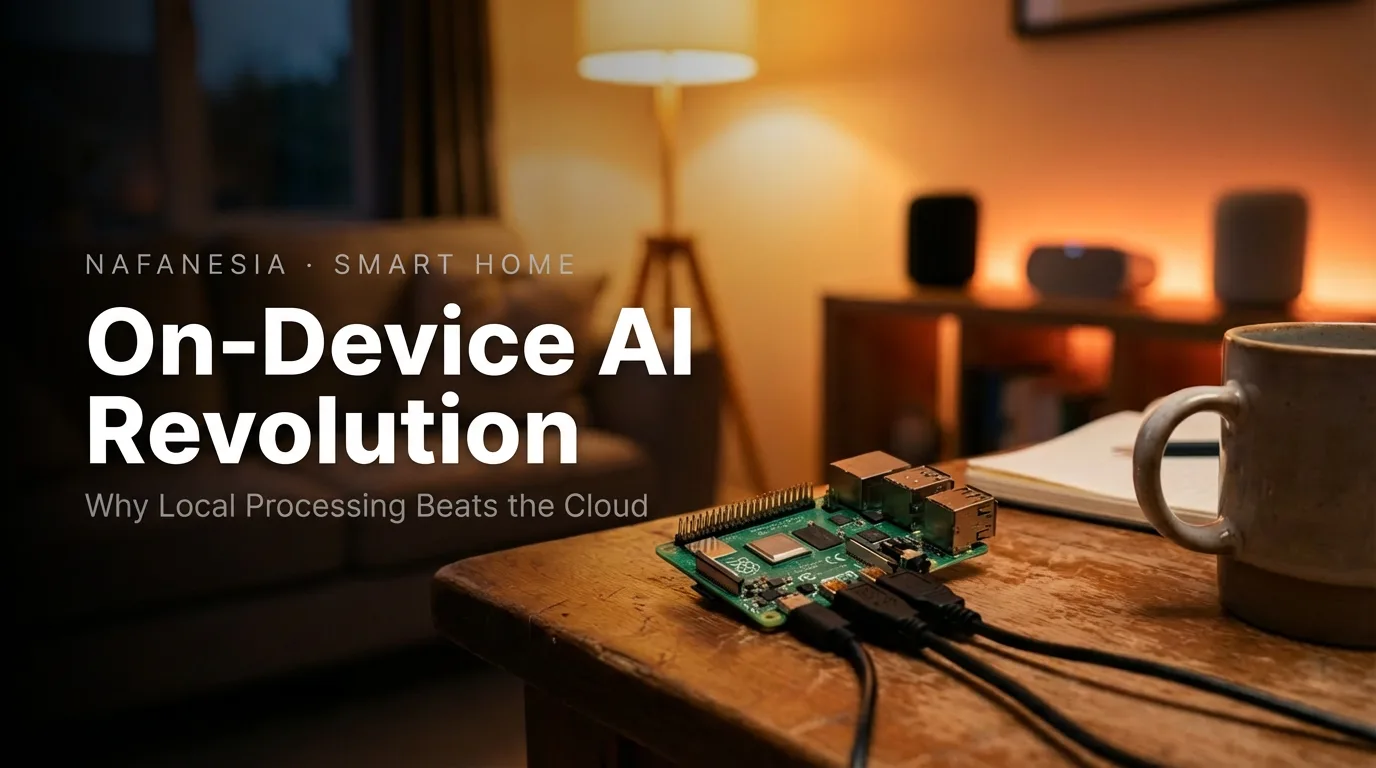
On-Device AI Revolution in Smart Homes: Why Local Processing Beats the Cloud
The smart home industry is undergoing a major transformation. From full reliance on cloud processing, it's now shifting toward on-device AI—technology that processes data directly on local devices like hubs, gateways, or smart sensors. This trend is driven by the need for lower latency, better privacy, and system reliability even when the internet goes down.
Why the Industry is Moving to On-Device AI
For years, voice assistants and smart home automation have relied on the cloud to process commands and run automation logic. However, this approach has several significant drawbacks:
- High latency: Every command must be sent to a server, processed, and the result sent back—taking 1-3 seconds
- Internet dependency: When connection drops, most smart home features stop working
- Privacy concerns: Voice, video, and occupant behavior data is stored on third-party servers
- Operational costs: Cloud servers require ongoing maintenance and bandwidth expenses
With advances in edge computing and the availability of chips with NPUs (Neural Processing Units), smart home devices can now run lightweight AI models locally.
Current Industry Data
According to IoT Analytics in their "State of the Smart Home 2025" report:
| Metric | 2024 | 2026 (Projected) |
|---|---|---|
| % Smart Home Devices with Local AI | 15% | 45% |
| Average Response Latency (ms) | 1,200 | 150 |
| Households with Privacy Concerns | 68% | 52% |
Source: IoT Analytics - State of the Smart Home 2025
Technologies Enabling On-Device AI
Several key technologies are making this revolution possible:
1. Small Language Models (SLMs)
SLMs are compact versions of large language models (LLMs) optimized to run on devices with limited resources. Models like Microsoft Phi-3, Google Gemma 2B, or Meta Llama 3.1 8B can run locally on smart home hubs with 4-8GB RAM.
# Example: Running local SLM with Ollama
import ollama

response = ollama.chat(
    model='phi3:3.8b',
    messages=[{'role': 'user', 'content': 'Is the living room light on?'}],
    options={'num_ctx': 2048}  # Small context window for efficiency
)

print(response['message']['content'])
References: Ollama - Local LLM Runner, Microsoft Phi-3 Technical Report
2. Neural Processing Unit (NPU)
Modern chips like Qualcomm Snapdragon 8s Gen 4, Nordic nRF54L Series, and Apple M-series come equipped with dedicated NPUs for AI inference. NPUs can run AI models 10-50x more efficiently than traditional CPUs.
3. Edge AI Frameworks
Various frameworks simplify AI model deployment to edge devices:
| Framework | Use Case | Device Support |
|---|---|---|
| TensorFlow Lite | Image classification, NLP | MCU, ARM, x86 |
| ONNX Runtime | General inference | Multi-platform |
| NVIDIA TensorRT | High-performance GPU inference | Jetson, RTX |
| Apache TVM | Model compilation & optimization | Heterogeneous hardware |
Sources: TensorFlow Lite Documentation, ONNX Runtime
Practical Implementation: Smart Hub with Local AI
Here's an example architecture of a smart home hub using on-device AI:
# System Architecture
┌─────────────────────────────────────────┐
│           Smart Home Hub                │
│  ┌──────────────┐  ┌─────────────────┐  │
│  │   ESP32-S3   │  │  Raspberry Pi 5 │  │
│  │   (Sensors)  │  │  (SLM + Logic)  │  │
│  └──────────────┘  └─────────────────┘  │
│         │                  │             │
│         └───── MQTT ───────┘             │
│                          │               │
│              ┌───────────▼───────────┐   │
│              │   Ollama + Phi-3      │   │
│              │   Local Intent Recognition │
│              └───────────────────────┘   │
└─────────────────────────────────────────┘
Implementation Steps:
- Setup Hardware Hub
- Use Raspberry Pi 5 (8GB RAM) or NVIDIA Jetson Nano as central hub - Connect sensors via Zigbee/Z-Wave/MQTT
- Install Local AI Runtime
# Install Ollama on Raspberry Pi
   curl -fsSL https://ollama.ai/install.sh | sh

   # Download SLM model
ollama pull phi3:3.8b- Develop Intent Recognition Logic
# intent_processor.py
   from openai import OpenAI

   client = OpenAI(base_url="http://localhost:11434/v1", api_key="not-needed")

   def process_voice_command(command):
       response = client.chat.completions.create(
           model="phi3:3.8b",
           messages=[
               {
                   "role": "system",
                   "content": "You are a smart home assistant. Extract intent and parameters from user commands. Output format: JSON with keys: action, device, location, value"
               },
               {"role": "user", "content": command}
           ],
           temperature=0.1,  # Low temp for deterministic output
           max_tokens=200
       )
return response.choices[0].message.content- Integrate with Home Assistant
# configuration.yaml - Home Assistant
   rest_command:
     ai_intent_handler:
       url: http://localhost:8080/process_intent
       method: POST
       content_type: application/json
       payload: '{"text": "{{ voice_command }}"}'
References: Home Assistant Integration Guide, Raspberry Pi Ollama Setup
On-Device AI vs Cloud-Based AI Comparison
Tip: For critical applications like security systems or medical monitoring, always prefer on-device processing to ensure operation continues even when internet is down.
| Aspect | On-Device AI | Cloud-Based AI |
|---|---|---|
| Latency | <200ms (local) | 1000-3000ms (round-trip) |
| Privacy | Data stays in local network | Data stored on vendor servers |
| Reliability | Operates without internet | Requires stable connection |
| Cost | One-time hardware cost | Recurring API subscription |
| Customization | Full control over models | Limited to vendor features |
| Scalability | Limited by device compute | Near-unlimited cloud resources |
Challenges and Solutions
While promising, on-device AI implementation also has challenges:
1. Resource Constraints
Solution: Use quantized models (INT8/FP16) to reduce memory footprint. Tools like llama.cpp support efficient GGUF quantization.
# Example download quantized model
ollama pull llama3.2:3b-instruct-q4_K_M  # Quantized 4-bit
2. Model Updates
Solution: Implement OTA (Over-the-Air) update mechanism for AI models, similar to firmware updates.
3. Multi-Device Sync
Solution: Use federated learning where models learn from multiple devices but training remains local. See TensorFlow Federated.
The Future of AI in Smart Homes
Trends to watch:
- Contextual Automation: AI will understand occupant patterns and automate based on complex contexts (e.g., "work mode" adjusting lighting, AC, notifications based on calendar and habits)
- Predictive Maintenance: Sensors+AI can predict device failures before they occur
- Natural Language Interface: Control entire homes through natural conversation, not rigid commands
- Multi-Modal AI: Combination of voice, image (from cameras), and sensor data for holistic understanding
Companies like Aqara, Samsung SmartThings, and Hubitat are already integrating local AI into their product roadmaps for 2026-2027.
Conclusion
On-device AI represents the natural evolution of smart homes—from simple rule-based automation to intelligent systems that are adaptive, fast, and respectful of user privacy. With support from modern hardware (NPU-enabled chips) and software frameworks (TensorFlow Lite, Ollama, etc.), local AI implementation is now accessible to developers and enthusiasts.
For Indonesian IoT businesses and developers, this is a major opportunity to build competitive smart home solutions without relying on global cloud infrastructure.