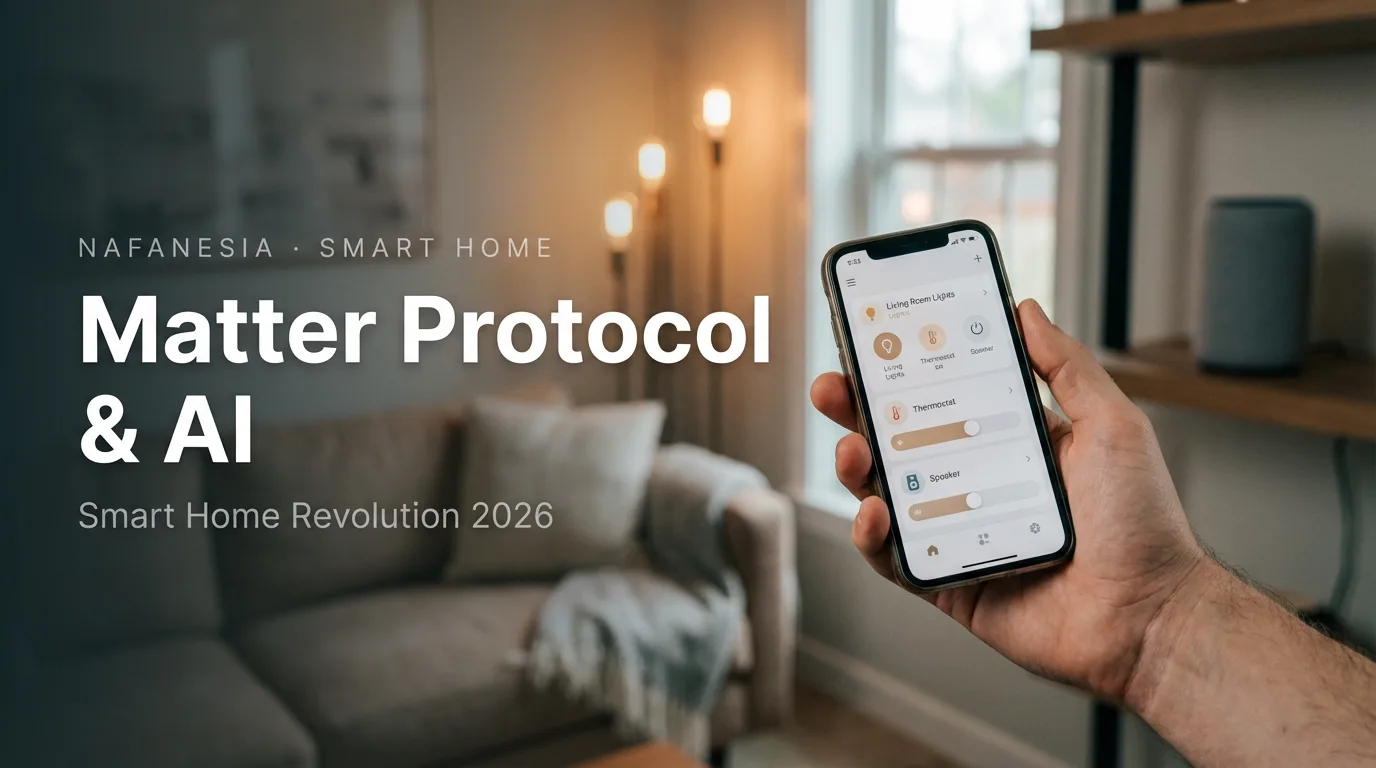
Matter Protocol and AI: The Smart Home Revolution of 2026
Smart homes have long been the dream of technology enthusiasts, but ecosystem fragmentation and setup complexity have often hindered mass adoption. In 2026, the combination of Matter protocol with artificial intelligence (AI) is dramatically transforming this landscape, delivering truly intuitive and interoperable home automation[^1].
What Is Matter Protocol?
Matter is an open-source connectivity standard developed by the Connectivity Standards Alliance (CSA) with support from tech giants like Apple, Google, Amazon, and Samsung[^2]. This protocol is designed to solve fragmentation issues by enabling smart home devices from different manufacturers to communicate seamlessly with each other.
Key Advantages of Matter Protocol:
- Universal Interoperability: Matter devices work together regardless of brand or platform
- Local-First Connectivity: Communication happens locally without cloud dependency
- Encrypted Security: Uses end-to-end encryption to protect user data
- Easy Setup: Device configuration with simple QR code scanning
- Open Source: License-free for manufacturers and developers[^3]
AI Integration in the Matter Ecosystem
The combination of Matter protocol with AI opens new possibilities for adaptive and contextual smart home automation. Here's how AI is transforming the smart home experience:
1. Machine Learning-Based Automation
AI can learn occupant behavior patterns and create personalized automations:
# Example: Adaptive automation with machine learning
from sklearn.ensemble import RandomForestClassifier
import numpy as np

class SmartHomeAI:
    def __init__(self):
        self.model = RandomForestClassifier()
        self.patterns = []

    def learn_behavior(self, time, temperature, occupancy, action):
        """Learn device activation patterns"""
        self.patterns.append([time, temperature, occupancy])
        actions.append(action)
        self.model.fit(self.patterns, actions)

    def predict_action(self, current_conditions):
        """Predict action based on current conditions"""
        return self.model.predict([current_conditions])[0]

# Implementation reference: https://github.com/home-assistant/core
2. More Natural Voice Control
AI language model integration enables voice assistants to understand complex context and intent[^4]:
| Feature | Traditional Voice Assistant | AI-Powered Assistant |
|---|---|---|
| Context Understanding | Limited | Multi-turn conversation |
| Personalization | Minimal | Learns from user preferences |
| Natural Language | Command-based | Conversational |
| Matter Integration | Manual | Auto-discovery & mapping |
3. Predictive Maintenance
AI can predict device failures before they occur:
Important Tip: Vibration sensors and power consumption can be analyzed with anomaly detection algorithms to detect potential IoT device malfunctions. Studies show predictive maintenance can reduce downtime by up to 50%[^5].
Tutorial: Setting Up Smart Home with Matter + AI
Here's a step-by-step guide to implementing a Matter-based smart home solution with AI integration:
Step 1: Hardware Preparation
Ensure you have Matter-compatible devices:
- Hub/Gateway: Apple TV 4K (gen 3), Google Nest Hub, or Amazon Echo (gen 4+)
- Matter Devices: Lights, switches, sensors that are Matter certified[^6]
- Edge Computing Device (optional): Raspberry Pi 4/5 for local AI processing
Step 2: Home Assistant Installation
Home Assistant is an open-source platform with full Matter support and AI integrations[^7]:
# Install Home Assistant OS on Raspberry Pi
# Download image from: https://www.home-assistant.io/installation/raspberrypi

# After booting, access web interface at http://homeassistant.local:8123
# Follow setup wizard and Matter integration will be auto-detected
Step 3: Pairing Matter Devices
The pairing process is remarkably simple using QR codes:
- Open Home Assistant → Settings → Devices & Services
- Click "Add Integration" → Select "Matter"
- Scan the QR code on the Matter device
- Device automatically connects and configures
Step 4: Implementing AI Automation
Use the Machine Learning add-on for predictive automation:
# Configuration.yaml - Example adaptive automation
automation:
  - alias: "Adaptive Lighting with AI"
    trigger:
      platform: sun
      event: sunset
    condition:
      condition: template
      value_template: "{{ states('person.home') == 'home' }}"
    action:
      service: light.turn_on
      entity_id: light.living_room
      data:
        brightness_pct: >
          {{ state_attr('sensor.occupancy_pattern', 'predicted_brightness') }}
        color_temp: >
          {{ state_attr('sensor.circadian_rhythm', 'recommended_kelvin') }}
Documentation reference: Home Assistant Automation
Real-World Case Studies
Several successful Matter + AI implementations across various sectors:
Retail and F&B
IoT for cold storage temperature monitoring with predictive alerts. The system can detect energy consumption anomalies and predict compressor failure 48 hours before occurrence[^8].
Smart Office
Lighting and HVAC automation based on occupancy prediction reduces energy consumption by up to 35%. AI learns meeting room usage patterns and adjusts environment before rooms are used[^9].
Residential Complex
A housing complex in Singapore implemented Matter-based smart homes with AI concierge. Residents can control all devices from a single app with natural language voice commands[^10].
AI Platform Comparison for Smart Home
| Platform | Matter Support | AI Capabilities | Local Processing | Price |
|---|---|---|---|---|
| Home Assistant | ✅ Full | ✅ Via add-ons | ✅ 100% | Free |
| Google Home | ✅ Full | ✅ Google AI | ⚠️ Partial | $99+ |
| Apple HomeKit | ✅ Full | ✅ Siri Intelligence | ✅ 100% | $149+ |
| Amazon Alexa | ✅ Full | ✅ Alexa AI | ⚠️ Partial | $99+ |
| Samsung SmartThings | ✅ Full | ⚠️ Limited | ⚠️ Partial | $70+ |
Data reference: CSA Matter Certified Products
Challenges and Considerations
While promising, there are several factors to consider:
1. Privacy and Data Security
Important: Ensure AI processing is done locally to minimize data breach risks. Edge computing with devices like Raspberry Pi or NVIDIA Jetson can run AI models without sending sensitive data to the cloud[^11].
2. Legacy Device Compatibility
Not all legacy smart home devices support Matter. Solutions include:
- Use Matter bridges/adapters
- Prioritize upgrading critical devices
- Check compatibility list at MatterWorks Database
3. AI Setup Complexity
AI implementation requires certain technical knowledge. Considerations:
- Start with pre-trained models
- Use platforms with user-friendly UI
- Consult experts for enterprise deployment
Conclusion
The integration of Matter protocol with AI marks a new era in smart home evolution. This combination solves historical fragmentation issues while adding an intelligence layer that makes home automation truly adaptive and personal. With Matter's universal interoperability and AI's learning capabilities, smart homes in 2026 are no longer just collections of connected devices, but ecosystems that understand and anticipate occupant needs.
To begin your smart home journey, start with Matter-certified devices and open-source platforms like Home Assistant. AI automation can be added gradually according to your comfort level and specific requirements.
Interested in more complex IoT implementations? Nafanesia provides consulting services and custom IoT solution development. Contact us.
References
[^1]: Connectivity Standards Alliance. "Matter Specification Overview." https://csa-iot.org/all-solutions/matter/ [^2]: Apple Inc. "Apple Joins Connectivity Standards Alliance to Help Develop Matter." https://www.apple.com/newsroom/ [^3]: Google Developers. "Working with the Matter protocol." https://developers.google.com/matter [^4]: Amazon Alexa Blog. "Alexa's Next Generation of AI." https://www.aboutamazon.com/news/alexa [^5]: McKinsey & Company. "Predictive maintenance use cases and ROI." https://www.mckinsey.com/capabilities/operations/our-insights/predictive-maintenance [^6]: Silicon Labs. "Matter Certified Devices List." https://www.silabs.com/matter [^7]: Home Assistant Documentation. "Matter Integration." https://www.home-assistant.io/integrations/matter/ [^8]: Industrial IoT Analytics. "Smart Manufacturing Trends 2026." https://iot-analytics.com/smart-manufacturing/ [^9]: Buildings.AI. "AI in Commercial Buildings Energy Efficiency." https://buildings.ai/research/ [^10]: Singapore Smart Nation. "HDB Smart Home Pilot Program." https://www.smartnation.gov.sg/ [^11]: Edge AI Research. "Local AI Processing for IoT Security." https://edgeai-research.org/security/